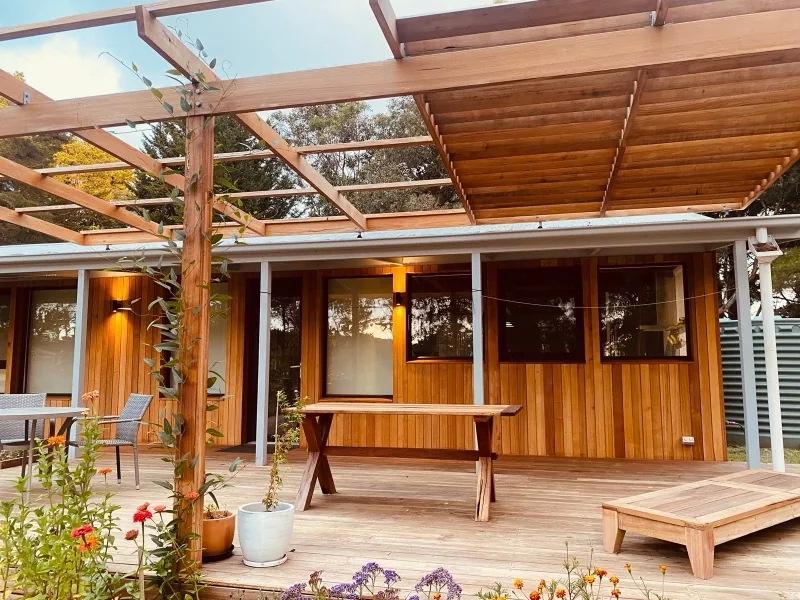
What's the difference between a pergola and a verandah?
A pergola has an open roof of beams or battens that filters sunlight, so it gives shade but does not keep rain off. A verandah has a solid, weatherproof roof and is attached to the house, so it stays dry and usable all year. Pick a pergola for shade and an open feel, a verandah for all-weather cover.
What is a pergola?
A pergola is an open, roofed structure. The roof is made of beams, rafters or battens spaced apart, so light and air pass through and the space sits somewhere between the garden and under cover. It gives shade and frames an outdoor room without closing it in.
A pergola can stand on its own over a patio, a pool or a corner of the yard, or attach to the house. Some have a fixed batten roof, others use louvres or an opening roof so you can dial the light and shade through the day. What a standard pergola does not do is keep the rain off. Water passes straight through the open roof.
There is more on the styles and timber in our Adelaide pergola guide.
What is a verandah?
A verandah is a roofed structure attached to the house, with a solid, weatherproof roof. Traditionally it runs along the outside of the home under the main roofline, though a modern verandah can be a dedicated outdoor area off the back.
Because the roof is sheeted and sealed, a verandah keeps rain and sun off and stays dry underneath. That makes the space usable in any weather, right through an Adelaide winter. A verandah reads as part of the house rather than a separate garden structure, so it ties into the existing roofline and drainage.
The key differences
It comes down to the roof and what you want the space to do. A pergola is open and built for shade. A verandah is roofed and built to keep the weather out. Here they are side by side.
| Feature | Pergola | Verandah |
|---|---|---|
| Roof | Open beams or battens, spaced apart | Solid, sheeted, sealed roof |
| Weatherproofing | Shade and shelter from the sun, open to the rain | Keeps rain and sun off, dry underneath |
| Attached or freestanding | Either. Attached to the house or freestanding in the yard | Usually attached to the house |
| Light and shade | Filters light for dappled, partial shade; louvres adjust through the day | Full cover, so more shade and a cooler, darker space |
| Council approval likelihood | A small, low, open pergola is more often exempt from planning consent | A solid roof and attachment to the house make approval more likely |
| Best for | Shade, an open outdoor feel, framing a space | All-weather use, keeping rain off, year-round outdoor living |
Where it gets blurry is the middle ground. A pergola with a solid or louvred roof starts to behave like a verandah, and in planning terms it may be treated as one. If you want the open look but need to stay dry, that is worth talking through before you settle on either.
Which one suits your place
Adelaide gives you long hot summers, strong sun and wet winters, so the choice often comes down to how you want to use the space and when.
A pergola suits you if you are after shade and an open, airy feel. Over a north or west-facing patio it takes the sting out of the afternoon sun in summer while still letting light and breeze through. With louvres or an opening roof you can close it up when you want more cover and open it when you want the sky. It sits lighter on the house and the garden.
A verandah suits you if you want the space usable in any weather. If you plan to sit out through winter, run an outdoor kitchen or dining area you use year round, or keep rain off a doorway or windows, the solid roof earns its place. It gives a cooler, more sheltered spot in summer too.
Plenty of homes end up with both, a verandah off the back door for the everyday and a pergola further out over the pool or the garden. There is no single right answer, and the honest one depends on your block, the aspect and how you live outside.
Do you need council approval?
Both can need approval, and it depends on the structure, not just the name. South Australia runs two separate consents, planning consent and building rules consent, and a project can need one, both or neither.
As a rough guide, a small, low, open pergola is more likely to be exempt from planning consent than a roofed verandah, because adding a solid roof and attaching it to the house tends to trigger approval. But the thresholds vary between councils and under the Planning and Design Code, so the size, height, roof and position on the block matter more than the name on the drawing.
We check the approval position for your build before any work starts, and factor any application into the plan and timeline. There is a fuller rundown in our guide to council approval for decks and pergolas in SA.
What each one costs
We don't put a headline price on either, because the figure only means something once we've seen the site. As a rule a verandah costs more than a pergola of the same size, because a solid, weatherproof roof, flashing into the house and proper drainage all add to the build. What moves the price on both:
Size and span. Bigger structures need heavier timber and more support.
Roof type. An open batten roof is one thing, a solid sheeted verandah roof or a louvred opening roof is another.
Attachment. Tying into the house, flashing and drainage add work a freestanding structure doesn't.
Timber and materials. Different hardwoods and roofing sit at different price points.
The site. Footings, access, slope and how it meets the house all add up.
Detailing. Posts, brackets and finish are where a build either looks considered or looks cheap.
We come out, measure up and put real numbers against your build, itemised so you can see where it goes. The material choice changes both the cost and the lifespan, which is the same thinking that runs through our decking timber guide.
Pergolas and verandahs, built by hand
We build both, in hardwood, sized and detailed for your site. Scotty is on every job from the quote to the handover. One crew, one standard, no subbies on the parts that matter.
We work across Adelaide's southern suburbs, the foothills and the Fleurieu, everything south of Anzac Highway. Whether it's an open pergola for shade or a roofed verandah for year-round cover, we'll talk through what suits your place, sort any approvals, and build it to handle the SA conditions. See our pergola work, or get in touch for a quote.
Pergola vs verandah, answered plainly
What is the difference between a pergola and a verandah?
A pergola has an open roof of beams or battens that filters sunlight, so it gives shade but lets rain through. A verandah has a solid, weatherproof roof and is attached to the house, so it keeps rain off and stays usable all year. A pergola can be freestanding or attached, while a verandah is always attached to the house.
Which is better for Adelaide, a pergola or a verandah?
Neither is better, they do different jobs. A pergola suits you if you want shade and an open feel over a patio or pool in the Adelaide summer. A verandah suits you if you want to use the space in any weather, including through winter, since the solid roof keeps the rain off. Plenty of homes have both.
Do I need council approval for a pergola or a verandah in SA?
It depends on the size, height, roof and position, not just the name. A small, low, open pergola is more likely to be exempt from planning consent, while a roofed verandah attached to the house is more likely to need approval. The rules vary by council and under the Planning and Design Code, so we check what your build needs before we start.
Can a pergola be made weatherproof?
Yes, up to a point. Add a solid or louvred roof and a pergola will keep more of the rain off, but once it has a fixed weatherproof roof it starts to behave like a verandah, and it may be treated as one for approval. If staying dry year round matters, a verandah or a louvred roof is usually the better call. We can talk through the options at the quote.
Not sure which one you need?
Tell us about your space and we'll be in touch within 24 hours. We'll talk through whether a pergola or a verandah suits your place at the quote visit, and sort the approvals as part of it.